
Thompson teaches authors to tell a linear story that winds through the hypertext they assembled working together. The stories suggest the most important pages and how they should be linked to make the alphabetized second half of the book, appropriately called the "garden".
WALK is a block that will explore the federation based on available sitemaps. Advancing through a graph node by node is sometimes called "walking the graph". We offer several ways to walk our hypertext. For example, `WALK 6 weeks` will explore week by week what a community has written. `WALK 10 hubs` will explore the vicinity of the 10 most frequently references pages. This will make dozens of small graphs, call aspects, some for weeks and some for hubs. The `SOLO` block will browse all of these at the same time pointing out where graphs overlap rendering them in in "gold" as if these are valuable finds.
This looks like:
WALK 6 weeks WALK 10 hubs SOLO
Mech blocks stack together to do many interesting computations. For Thompson's first and second books we wrote custom HTML scripts to assemble and review wiki pages organized front to back as a book. For the third book were reviewing more recent computational tools and find the outlook promising. This is some of the most interesting cooperations between new and existing blocks.
Thompson teaches authors to tell a linear story that winds through the hypertext they assembled working together. The stories suggest the most important pages and how they should be linked to make the alphabetized second half of the book, appropriately called the "garden".
Emerging practice is to favor garden pages based on how closely they are associated with the author's story. This is measured in the number of link "clicks" required to reach a page.
For the third book we offer a new way to walk through the neighborhood, We say `WALK 3 clicks` to collect pages no more than three clicks from the author's story. We can assess how well this matches the intention for a new volume using a simple stack of blocks.
WALK 3 clicks SOLO
We can approach a project by first exploring one click into the garden. These are called "gateway" pages because they have to set a new context for the reader. When this looks good its time to try two clicks and then three clicks. Three is the limit used on previous books.
We can replace SOLO here with PRINT, a new block built for assembling the third book. PRINT reads the aspects from WALK, assembles the full text of the chosen pages, and then downloads that as a new draft for the volume.
PRINT also produces a lot of statistics regarding all of the decisions it made as it batch process what was an interactive task with SOLO. These are reported as wiki page items that can be previewed and optionally saved with the PREVIEW block. This stack puts it all together, downloading the draft and showing in detail how this was assembled.
WALK 3 clicks PRINT draft PREVIEW synopsis items
While reviewing a draft one can consult the reported decisions. Further, one can save these pages documenting variations that were tried while progressing toward a finished draft.
At Thompson's suggestion, we label these reports with a timestamp and the walked aspects as just another clickable item to open up the SOLO view into what was given to PRINT. Wiki's flexible JSON format makes this history easily recored, lined up maybe side by side with previous runs, and click into a graph browser to review the walks that might or might not been as intended.
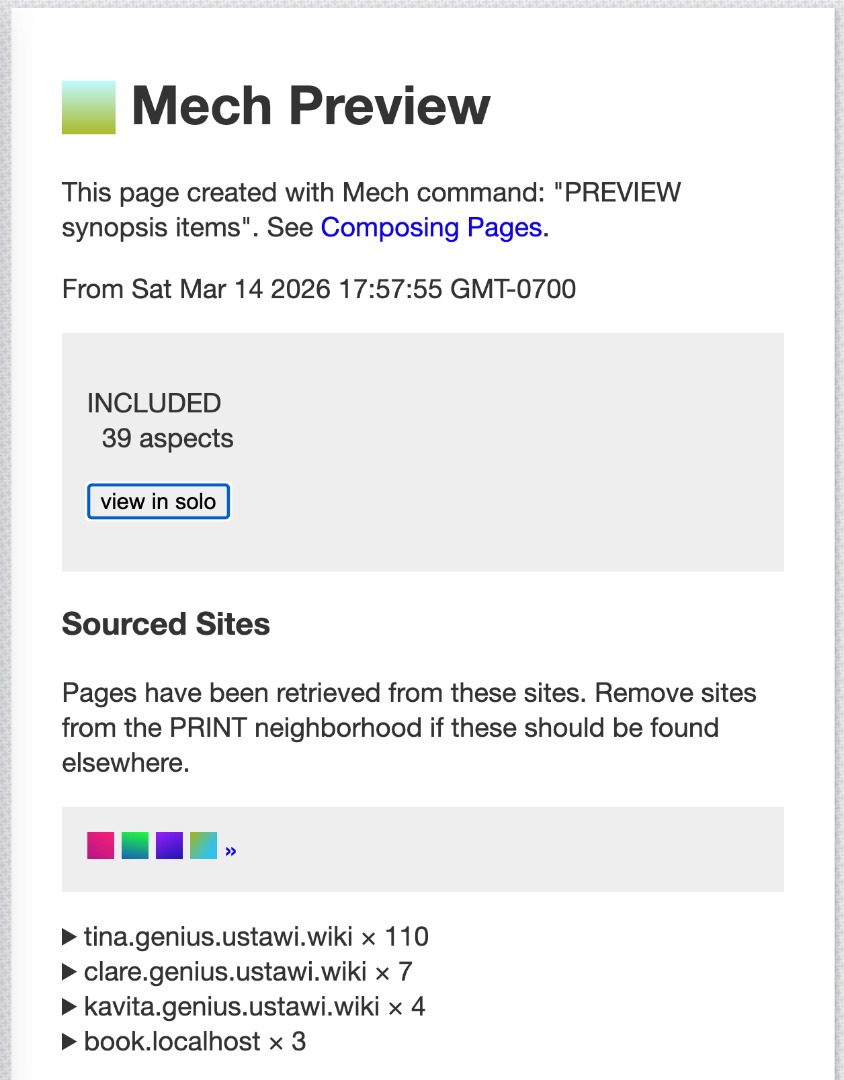
Output from the PREVIEW block.
In practice a Mech script will include additional blocks to setup the neighbors to be used in each place and probably adding click-to-run blocks around sections that might be repeated before advancing. We'll share these as they are proven useful.
.
Are these books public? I'd love to browse one of them.
Thank you for that question. Did you want to see the finished product or the pieces that came together? Now would be a good time for me to review the previous work so that we leave an even better record of future projects. Here is an interesting artifact from the last book:
Over a period of three years three authors wrote a complex book, The Joyful Sandbox, based on the experience of the first author, later turned editor, Thompson Morrison when he wrote The Dayton Experiment.
Tip: There is a lot more history online. Follow the back links from the above page to find more production notes. Regretfully many notes explaining the scripts used are not near as overt as we want for Mechs.
.
Another artifact, this one from the author's perspective, that sought to remember the experience of writing the first book, The Dayton Experiment, using a new narrative paradigm. It's in the process of manifesting these books into printed form that we are making great strides, a challenge more complex with multiple authors.
I wrote in my original wiki for about a year before it began to feel a sense of wholeness – some 450 pages that held the deeper learning of my experience of introducing the Agile Mindset to educators.
Welcome to our book, _The Dayton Experiment_. This book explores our journey over the last six years of introducing agile culture to the realm of education. This book will be added to over time by others so to broaden the perspectives and the insights from this experience.